
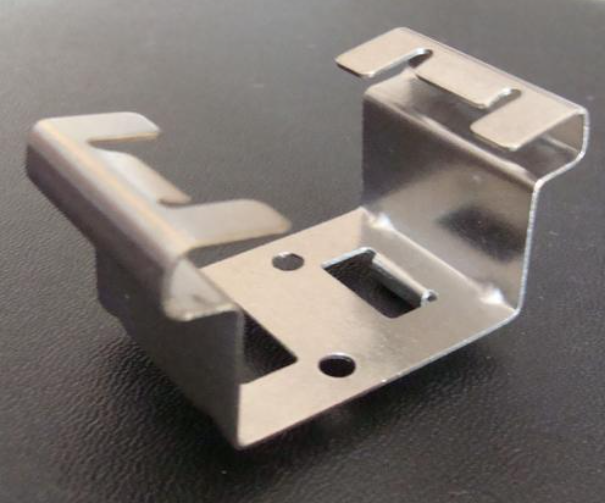
In the manufacturing of electronic hardware components, high-strength cold work hardened steel strips are highly favored due to their ability to achieve high tensile strength without requiring subsequent heat treatment. However, high strength is frequently accompanied by a sacrifice in plasticity. Recently, an electronic product manufacturing enterprise we service encountered a tricky challenge: The customer has been using a batch of DC01-C690 cold-rolled hardened steel strips with a specification of 1.8 × 120mm and an order quantity of 2 tons. However, during actual stamping and bending operations, the product frequently cracks at the second bending zone when undergoing two consecutive bends.
To thoroughly resolve the customer's pain points, we promptly acquired the failed samples from the site and conducted in-depth physicochemical and process analyses. This article combines this failure case to thoroughly dissect the micro-characteristics, root causes of cracking, and solutions for the DC01-C690 material.
I. Phenomenon Review and Root Cause of Failure: The Inherent Contradiction Between High Strength and Extremely Poor Plasticity
Through observational review of the customer's cracked samples, the electronic hardware part requires two consecutive bending operations, with cracks erupting without exception in the deformation zone of the second bend.
Looking at the material grade, DC01-C690 belongs to the European standard cold work hardened steel strip, with a tensile strength as high as 690MPa or more. This product relies entirely on the cold work hardened reduction process for strengthening during manufacturing:
1. Fibrous Grain Structure: After heavy-deformation cold rolling, the grains inside the material are severely elongated, forming a typical "fibrous" structure.
2. Physical Nature of Extremely Poor Plasticity: Due to extremely high dislocation density and restricted slip systems, the material in this state exhibits extremely poor plasticity and elongation. When subjected to secondary complex bending, local stress rapidly accumulates and exceeds the fracture limit, easily triggering brittle cracking.
II. Behind the Scenes: The Critical Influence of Base Metal Genes and Chemical Composition (C, Mn)
In addition to the inherent high brittleness brought by the work-hardened state, spectroscopic analysis revealed that the cracking resistance of such highly hardened steel strips is intrinsically linked to the selection of the base metal:
1.Fine Control of Carbon (C) and Manganese (Mn): The carbon content of the base metal directly determines the upper limit of the material's matrix hardness, while manganese plays a key role in grain refinement and solid-solution strengthening. If the initial composition of the base metal exhibits segregation or a high carbon equivalent, its brittleness will be further amplified after cold working.
2.Micro-Cleanliness: For thicker narrow strips up to 1.8mm, the control of non-metallic inclusions in the base metal is equally critical. Tiny inclusions easily evolve into micro-crack sources in the high-strain zone of secondary bending, causing the workpiece to experience immediate brittle fracture.
III. Breaking Through: How to Help C690 Pass the Bending Test Successfully?
Faced with such a tough challenge like C690 with a tensile strength ≥690MPa, blindly applying conventional stamping parameters when bending is required by structural design inevitably leads to high scrap rates. To address this, we proposed two practical breakthrough solutions:
1. Base Metal Composition Optimization and Strip Condition Fine-Tuning: By strictly screening premium base metals with lower carbon and higher cleanliness, and optimizing the deformation distribution during rolling, the uniformity of the material's microstructure is improved as much as possible while ensuring the tensile strength standard is met.
2.Customized Process and Heat Treatment Testing:
Bending Direction Optimization: Adjust the blanking direction of the stamping blank so that the bending line maintains a perpendicular or specific safe angle with the rolling direction (fiber streamline), leveraging micro-anisotropy to enhance cracking resistance.
Local Stress Relief or Intermediate Softening Annealing: For the two-stage bending process path, we suggest customers introduce thermal assistance after the first bend or evaluate local stress-relief options to release partial work-hardening stress; or adjust the ordering state (such as adopting a lower strength grade or specified annealed-plus-skin-passed state) to fundamentally balance strength and bending plasticity.
From the precise dimensional control of the 1.8 × 120mm specification to the customized process output for the 2-ton order, we are helping electronic manufacturing enterprises completely bid farewell to stamping and cracking troubles through full-process failure analysis and technical support, achieving a perfect balance between high strength and high formability!
Baoshan District,
Shanghai, China.