
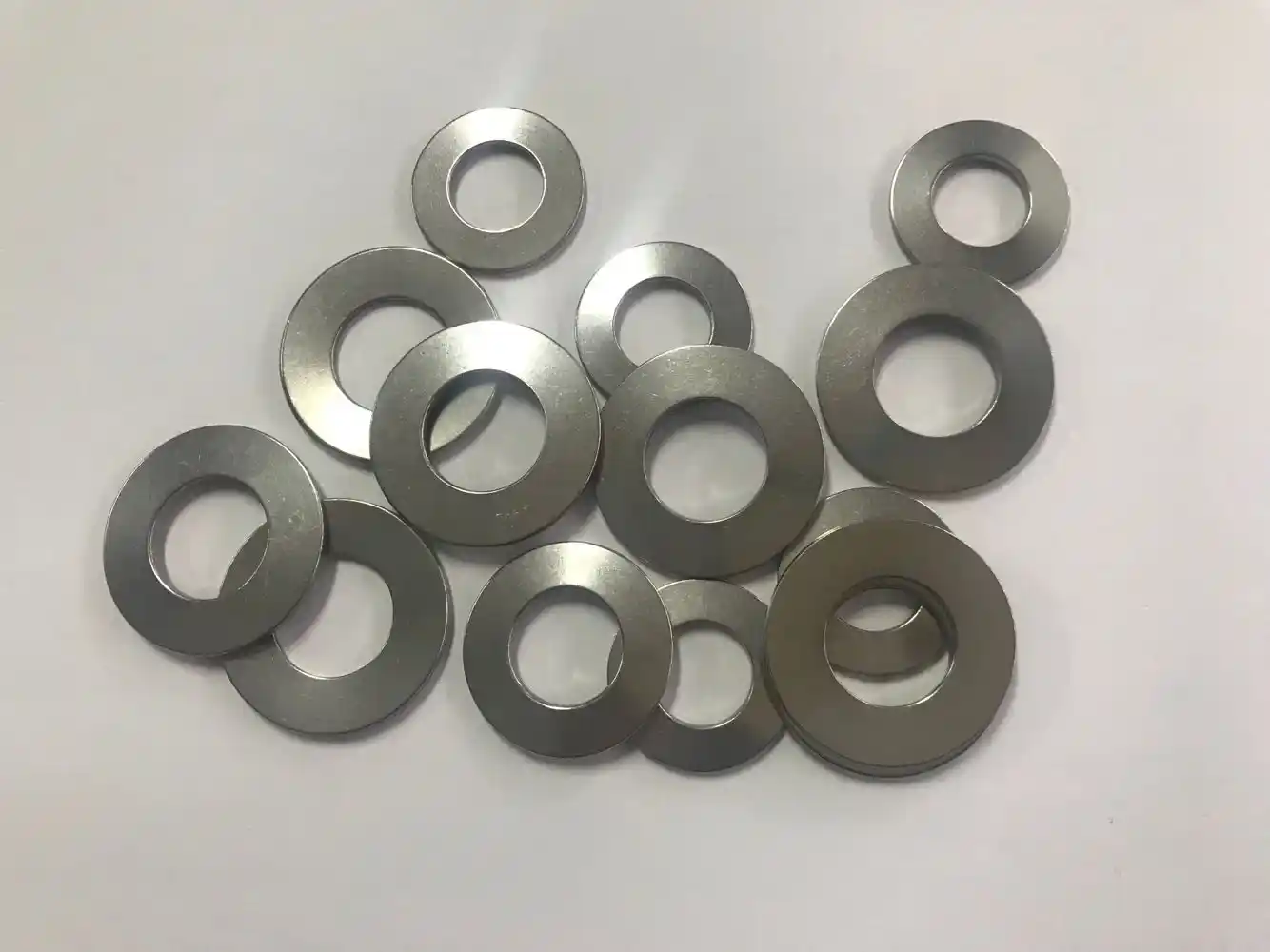
In the manufacturing of high-performance disc springs (Belleville washers), 50CrV4 and 51CrV4 are the two most prominent alloy spring steels. Although both belong to the Chromium-Vanadium (Cr-V) family, subtle yet critical differences in micro-element control and dynamic load performance set them apart. Leveraging our expertise in precision cold-rolling, ALLOWORD deconstructs the selection logic between these two materials.
1. The Logic of Strength and Toughness Behind Chemical Micro-adjustments
While their basic compositions are similar, the precise ratio of alloying elements determines their performance under different working conditions:
50CrV4 (1.8159): With a carbon content of approximately 0.50%, its core advantage lies in an excellent balance of toughness and fundamental hardenability. It is a cost-effective choice for static or medium-to-low frequency load scenarios.
51CrV4 (1.8161): Featuring a slightly higher carbon content and Vanadium (V) levels increased to 0.2%–0.3%. This higher Vanadium content produces a significant grain-refinement effect, granting the material superior creep resistance and high-temperature strength.
【The ALLOWORD Advantage】: Our 50CrV4/51CrV4 precision strips undergo 100% Hydrogen Atmosphere Annealing to strictly control decarburization depth. For disc springs, "zero decarburization" at the surface is the lifeline for guaranteed fatigue life.
2. Performance Showdown: Dynamic Loads vs. Extreme Environments
In practical disc spring applications, the divergence between the two grades is evident in three dimensions:
High-Temperature Stability: Due to superior tempering stability, the mechanical strength of 51CrV4 decays much slower than 50CrV4 in environments exceeding 200°C.
Fatigue Life: Under high-stress cyclic loads (reaching millions of cycles), the refined grain structure of 51CrV4 effectively inhibits the initiation of micro-cracks.
Low-Temperature Toughness: 50CrV4 performs better in extremely cold environments (below -20°C), showing a lower risk of brittle fracture.
3.Typical Application Scenarios & Selection Guide
|
Application |
Recommended Grade |
Core Reason |
|
Automotive Clutch / General Buffers |
50CrV4 |
Primarily static loads; high cost-performance ratio; excellent processability. |
|
Aerospace Valves / Heavy-duty Safety Valves |
51CrV4 |
Handles high-temperature and high-frequency dynamic loads; ensures extreme safety. |
|
Precision Die Springs |
51CrV4 |
Requires exceptional dimensional tolerance retention and ultra-long fatigue life. |
4. Global Standard Cross-Reference (ALLOWORD Supply Capability)
As a staple in high-end international industrial sectors, 51CrV4 enjoys higher global recognition. ALLOWORD provides precise material matching according to your regional standards:
European Standards: Compliant with EN 10089 (50CrV4) and EN ISO 6931-2 (51CrV4).
American Standards: Equivalent to ASTM 6150, widely used in aerospace and general machinery.
Japanese Standards: Equivalent to JIS SUP10, satisfying the rigorous requirements of precision electronics and damping systems.
5. How to Choose the Right Substrate?
Choose 50CrV4: If your project is budget-sensitive and the working conditions are relatively stable.
Choose 51CrV4: If your product faces high-stress cycles or high-temperature environments, selecting 51CrV4 will significantly reduce the risk of after-sales failure.
At ALLOWORD, we do more than supply raw materials. Through ±0.005mm precision tolerance control and customized heat treatment solutions, we solve the pain points of stress inconsistency in disc spring forming.


Baoshan District,
Shanghai, China.