

Daily press, 2026-02-26, 03:29 pm
Identification of Martensite, Bainite and Pearlite Microstructures in Steel
In practical applications, accurately distinguishing between martensite, bainite, and pearlite structures in steel is critical for evaluating steel properties and developing appropriate heat treatment processes. The following are common identification methods:
Optical Microscopy Observation
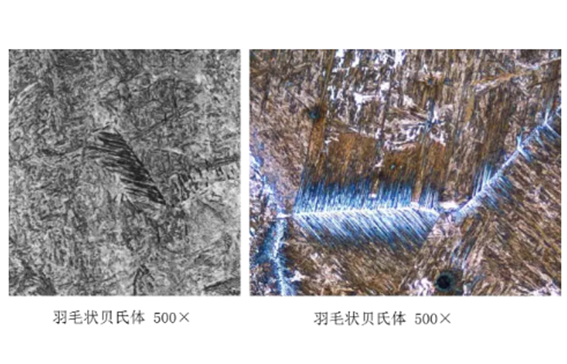
The microstructure of steel is observed using an optical microscope. Martensite appears dark, needle-like or lath-like; bainite appears gray, feathery, needle-like or granular; and pearlite shows a lamellar structure with alternating light and dark layers.
Electron Microscopy Observation
Electron microscopes such as scanning electron microscopes (SEM) or transmission electron microscopes (TEM) are used to examine the fine microstructure of steel. They allow clearer observation of the substructures and morphological differences among various phases.
X‑Ray Diffraction Analysis
X‑ray diffraction (XRD) is used to analyze the phase composition of steel. Different microstructures exhibit distinct diffraction patterns, enabling accurate identification of martensite, bainite, and pearlite.
Hardness Testing
The microstructure type can be indirectly determined through hardness testing. Generally, martensite has the highest hardness, followed by bainite, while pearlite has relatively lower hardness.
Heat Treatment Experiments
By simulating different heat treatment processes such as quenching and tempering, the microstructural changes in steel are observed. Different microstructures can be distinguished according to the characteristics and laws of phase transformation.
Related Reading

Other News
Contact and Support

Ilin Ye
Steel Business Manager
5F, Building 7, No. 7 Youyi Road,
Baoshan District,
Shanghai, China.
Baoshan District,
Shanghai, China.
t/f: +86 (0)21 56162819
m: +86 15618590326
Further questions?

Please feel free to contact us for more information or enquiries.